The Mojave War, 1858-1859
What the record shows, where the sources disagree, and how the Mojave remember it.
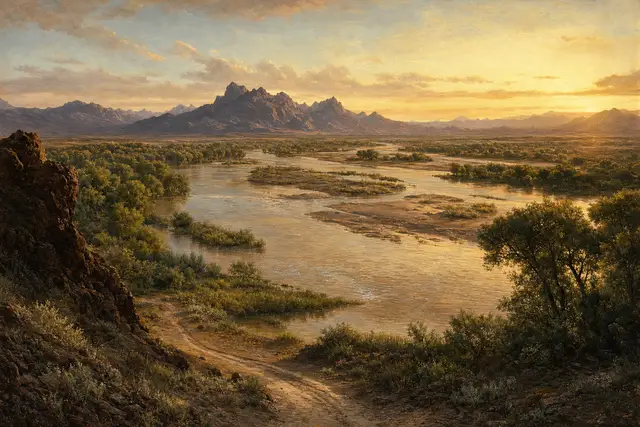
The Colorado River near the crossing, as it may have looked in 1858.AI illustration · artistic interpretation
The people by the river
For centuries before any wagon arrived, the Mojave, who call themselves Pipa Aha Macav, "the people by the river," farmed the floodplain of the Colorado in what is now the tri-state corner of Arizona, California and Nevada. Each summer the river rose and fell, leaving fresh silt in which they planted corn, beans, pumpkins and melons. The crossing in the Mojave Valley sat on Indigenous trade routes that historian Natale Zappia describes as an "interior world" reaching from the Pueblos of New Mexico to the coast of California.[Zappia]
Americans had been passing through for a generation. The trapper Jedediah Smith was fed and guided by the Mojave in 1826; on his return in 1827, after other trappers had spilled blood, his party was attacked at the crossing. In 1854 Lt. Amiel Whipple's railroad survey crossed the valley, guided by Cairook and Irataba, and in early 1858 Lt. Joseph Ives brought the steamboat Explorer upriver with Cairook as a guide.[Ives; Kroeber]
Beale's road and the Rose-Baley party
In 1857 Edward F. Beale surveyed a wagon road along the 35th parallel from New Mexico to the Colorado, using a train of imported camels. Where it met the river became known as Beale's Crossing, in the Mojave Valley north of present-day Needles, California.[Beale]
In the summer of 1858 the Rose-Baley party, the first emigrant train to try the new road, left Albuquerque with families, wagons and a large herd of cattle, led by Leonard John Rose and Gillum Baley. The Baptist lay preacher John Udell kept the only known daily journal of the journey.[Udell; Baley]
August 30, 1858
At the river the emigrants began building rafts, and they cut cottonwoods the Mojave considered their own. To the river people these trees meant shade, building posts, cradleboards and the wood of cremation fires. The cattle, the cutting and the fear that the strangers meant to stay all fed what came next.
On August 30, 1858 the river camp was attacked. Twelve-year-old Sallie Fox raised the first alarm and was wounded by an arrow; her apron is preserved in a museum in Vacaville, California. At the river camp one man was killed and about a dozen were wounded. The Bentner family, camped apart from the train, were all killed.[Udell; Baley]
The emigrants lost nearly all their livestock and turned back toward New Mexico. Westbound emigrant Edward Smith turned his own party around to help them. Mary Brown carried her infant son through the retreat; he died before they reached Albuquerque.
The Army comes
When news reached California, the Department of the Pacific under Gen. Newman S. Clarke sent Lt. Col. William Hoffman toward the river. At the end of December 1858 Hoffman marched about fifty dragoons to the Colorado; in January 1859, near Beaver Lake, his camp was threatened, his men fired, and he withdrew to press for a larger force.[Utley; Avillo]
He came back in April 1859, up the river from Fort Yuma, with more than six hundred men (infantry, a few dragoons and two mountain howitzers). On April 19, 1859 the post was planted on the east bank as Camp Colorado; on April 28 it was named Fort Mojave.[Avillo]
The council and Cairook
On April 23, 1859, Hoffman called the Mojave leaders to a council inside a ring of soldiers and dictated terms: the Mojave would not oppose roads or forts, would not touch travelers, and would give hostages. When the Americans demanded the hereditary chief, Homoseh quahote, the sub-chief Cairook offered himself in his place. He and eight others were taken downriver to Fort Yuma.
On June 21, 1859, during a turn in the yard, Cairook seized a guard so the other prisoners could run, and he was bayoneted and shot. The manner of his death is preserved both in the Army record and in Fort Mojave tradition, which, as the elder Frances Stillman told it to historian Lorraine Sherer, remembers it as a deliberate sacrifice. Accounts differ on how many fell beside him.[Sherer]
August 4, 1859, and the peace
The one pitched battle of the war was fought on August 4, 1859, about twelve miles below the fort, when Capt. Lewis Armistead and Lt. Elisha Marshall, with some fifty men, struck a Mojave force of more than two hundred. By the Army's count twenty-three Mojave were killed and three soldiers wounded.
Soon afterward the Mojave made the peace they kept from then on. Irataba, who had argued against the war, became the leader most of the nation followed, and in 1864 he traveled to Washington and met President Abraham Lincoln.
What came after
Fort Mojave was abandoned and burned in 1861, early in the Civil War, and regarrisoned by California Volunteers in 1863. In 1890 it became the Fort Mojave Indian School, which operated until 1931; there, Mojave children were punished for speaking their language. In the 1930s Hoover Dam ended the river's annual flood. In March 2023, Avi Kwa Ame (Spirit Mountain), the sacred mountain at the center of Mojave creation, became a national monument of about 506,814 acres, with provisions for tribal co-stewardship.[Stewart; BLM]
Today the Fort Mojave Indian Tribe's headquarters stand in Needles, California, downriver from the old crossing. The Tribe has worked for years to bring the Mojave language back, recording elders and teaching it to children. To learn more from the Tribe directly, visit the Fort Mojave Indian Tribe's official site.
Sources
- Baley, Charles W. Disaster at the Colorado: Beale's Wagon Road and the First Emigrant Party. Logan: Utah State University Press, 2002.
- Udell, John. Journal of John Udell, Kept During a Trip Across the Plains. Jefferson, Ohio, 1868.
- Kroeber, A. L., and C. B. Kroeber. A Mohave War Reminiscence, 1854-1880. Berkeley: University of California Press, 1973 (Dover reprint, 1994).
- Sherer, Lorraine M., with notes by Frances Stillman. Bitterness Road: The Mojave, 1604 to 1860. Menlo Park: Ballena Press, 1994.
- Avillo, Philip J., Jr. "Fort Mojave: Outpost on the Upper Colorado." Journal of Arizona History 11, no. 2 (1970): 77-100.
- Ives, Joseph C. Report upon the Colorado River of the West. Washington, D.C.: Government Printing Office, 1861.
- Beale, Edward F. Report concerning the wagon road from Fort Defiance to the Colorado River. Washington, D.C., 1858.
- Utley, Robert M. Frontiersmen in Blue: The United States Army and the Indian, 1848-1865. New York: Macmillan, 1967.
- Stewart, Kenneth M. "A Brief History of the Mohave Indians Since 1850." The Kiva 34, no. 4 (1969): 219-236.
- Zappia, Natale A. Traders and Raiders: The Indigenous World of the Colorado Basin, 1540-1859. Chapel Hill: UNC Press, 2014.
- Lingenfelter, Richard E. Steamboats on the Colorado River, 1852-1916. Tucson: University of Arizona Press, 1978.
- Bureau of Land Management. Avi Kwa Ame National Monument. blm.gov
- Fort Mojave Indian Tribe. Official website. mojaveindiantribe.com